From July 3 to 5, 2026, the “15th International Academic Conference on Quantitative Economics 2026,” hosted by the Center for Quantitative Economics and the School of Business and Management at Jilin University, was held in Changchun. The conference was co-organized by Jilin University Journal Social Sciences Edition, Quantitative Economics Research, Beijing Youwan Information Technology Co., Ltd., and StataCorp LLC. Against the backdrop of a new global economic landscape, the conference closely followed China’s new development philosophy, focused on the frontiers of theoretical innovation and practical application in quantitative economics, and sought to pool international academic strength for building China’s independent knowledge system in economics.
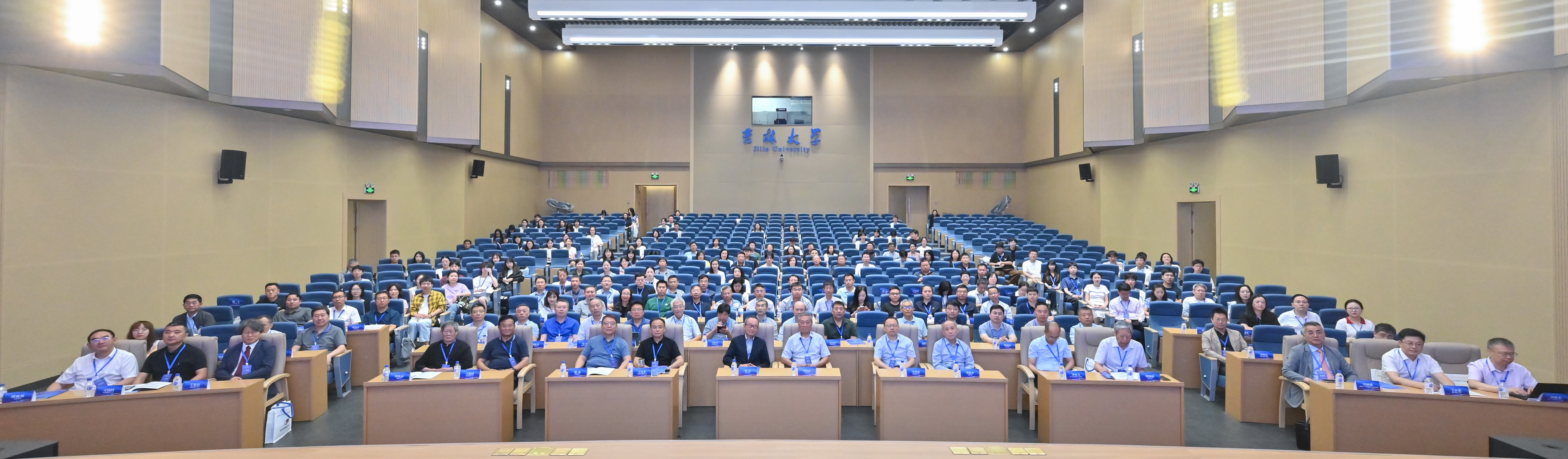
The opening ceremony was chaired by Sun Wei, Director of the Center for Quantitative Economics at Jilin University. Wang Wenju, Vice Chairman of the Chinese Association of Quantitative Economics, and Sui Jianli, Dean of the School of Business and Management at Jilin University, delivered speeches respectively. Sui Jianli noted that the conference coincides with the 80th anniversary of Jilin University, the 40th anniversary of the approval of the master’s program in quantitative economics, and the 25th anniversary of the discipline’s designation as a national key discipline. He said that in the era of artificial intelligence and big data, it is necessary to consolidate theoretical foundations, ground research in Chinese practice, and promote interdisciplinary integration and industry-academia-research collaboration.
At the keynote session, Zhang Jun, Wen Quan, Wang Weiguo, Zhu Xiaodong and Fang Yi delivered reports on topics including technological innovation models with Chinese characteristics, multi-stakeholder bargaining and public policy consultation, fertility policy and long-term economic growth, China’s economic growth miracle from the perspective of institutional change, and financial market development and wealth governance from the perspective of common prosperity. The session was chaired by Zhang Xiaotong and Wang Linhui. The conference featured 19 invited presentations, focusing on causal inference with deep learning, the impact of AI on employment and income, structural evaluation of fiscal policy, and mechanism design for digital platforms, and also set up special sessions on big data and artificial intelligence.
The conference received 358 submissions from universities and research institutions at home and abroad, accepted 90 Chinese and English papers, and organized six parallel forums and five doctoral forums. Topics covered quantitative economics methods, big data and artificial intelligence, macroeconomic theory and policy, microeconomic behavior and enterprise development, financial markets and risks, the digital economy and social impact, and human capital and income distribution. The conference systematically showcased the latest achievements in China’s quantitative economics and built a high-end platform for open exchange and deepened cooperation among scholars at home and abroad.